Showing posts with label TAI 2018. Show all posts

Saturday, January 26, 2019

TAI CONCLUSION - 2018

TAI CONCLUSION - 2018


My findings around the need for fantasy in the classroom to aid engagement and therefore achievement are summised in my Prezi presentation.


I spoke at the Joy of Play conference on January 23rd 2019 on this subject.  Sharing my findings.

An excerpt of feedback from the seminar.


Thursday, November 8, 2018

SPIRAL THREE - Play Planning Template

Play Planning Template

SPIRAL THREE - Play Planning Template

Rationale:

To have a play planning template that allowed for all the links to the curriculum, urges and school values to be tracked.


What works:

  • Great for reflecting on what is happening in the play and linking with the curriculum.  
  • The information around urges and play types keep the resourcing and provocations personalised for the children and what they are interested in.

What needs tweaking:

  • Add in school values.

Friday, August 24, 2018

SPIRAL TWO - Can fantasy be used to engage children in all ELA's?

Can fantasy be used to engage children in all ELA's?


Findings:


  • Science, Literacy and Mathematics (especially 'strand' concepts) is easily woven into play organically.  Within science, Planet Earth & Beyond is not quite so easy and needs specific planning for.  As does music (to be taught well) and certain art skills. 
  • Parts of technology needs to be understood developmentally in order to see in play.  Because it is steeped in planning, it's important to understand that a 5 year olds 'planning' is very much on the fly and constantly changing!  It's probably better described as sustained focus on a project.

Next step:


  • Develop a planning template that allows me to track coverage.


Wednesday, June 6, 2018

SPIRAL TWO - Can we explore the new digital curriculum in a developmentally appropriate way using fantasy?

Can we explore the new digital curriculum in a developmentally appropriate way using fantasy?


Key Learning Points for me:

  • Unpacking the digital curriculum made me realise that I didn't understand a lot about the different processes around the digital curriculum.  We worked on coordinates, direction and coding (beebots and scratch jnr).  I would now like to learn more about this digital technologies and have made sure I am signed up for this new contracted PLD at Waipawa School next year!


Tuesday, May 1, 2018

SPIRAL ONE - Fantasy play developing

Evidence of the fantasy play that is developing (thanks to Roomble Froomble) is found on the following narrative assessment link:


Pesky Pirates


This learning story outlines the curriculum coverage including ELA's and KCs.

Next step:

Can we explore the new digital curriculum in a developmentally appropriate way using fantasy?


Wednesday, April 25, 2018

Ali Carr-Chellman

Engaging the Disengaged Learner

Ted talk
Energize Conference - Day 1 - Keynote

"Bring back the boys - gaming to re-engage disengaged learners" (book)

US stats
75-80% of all ADHD medications are give to US boys.  Are we medicating them because they are boys?
4 X as likely to be diagnosed with ADHD if you are a boy.
3 X as likely to be suspended, expelled, in special education if you are a boy.
For every 100 women who earn a bachelor's degree, only 73 men earn one.  Women outnumber men obtaining master's degrees by more than 30%.

Why?
Zero tolerance policies (if you play guns, you will stay in at lunch).  Too many things that engage our boy learners, are outlawed in school.
Compressed curriculum (3 R's alone)
Cultural differences (Schools not current enough.  'Millennials' are their own culture with their own needs.  They are disengaged for 6 hours at school and head home for education to begin).

What can we do?
Fluidity, Improvisation - key aspects to learning that engages our disengaged learners.

Gaming
  • Minecraft (education option).
  • OTS (off the shelf gaming).  What can you learn from games that already exist for public consumption?
  • Failing at a game is a way for millennials to now explore failure in a way that other peers that do not game, do not experience.  Therefore they explore the emotions for failure as well as problem-solving and perseverance skills.  Communication and people skills (eg, teamwork) is incorporated also.
  • Don't use educational simulation games.  Disengaged learners like the gory stuff!
Key points
  • Forces a culture shift.   Respect and trust from adults.
  • Design based thinking.
Examples:
One Stone
Circle School
CLC (Centre Learning Community)

"An educational system isn't worth a great detail if it teaches young people how to make a living but doesn't team them how to make a life."

Reflection

  • Gaming isn't something that I want to focus on in my Year 2 room at this stage.  We are not equipped with devices that will run Minecraft efficiently either.  However the ideas of boys being treated differently throughout the system is pertinent to my work in a boy heavy classroom.  Key points to take away when designing my play programme:
    - less rules on the play (freedom within a framework)
    - the 3 R's alone is not enough to engage our boys meaningfully.  Context needed.
    - these children are millenials and need engaging for this culture.  What is this culture?

Action

Louie working on measuring through the Roomble Froomble potion making guise.

Coby writing down his potion because of this context also.

Saturday, April 7, 2018

SPIRAL ONE - The "hook"

How to make sure everyone is on board with The Wizard...


To be able to capitalise on Roomble Froomble so that his 'magic' lasts a large proportion (if not all) of the year, I need to make sure that the children are completely hooked.

Roomble Froomble invites them to his magical place in the bush.  This linked to all sorts of work to do with literacy writing ( see Seesaw link) and worked as a large curriculum focus.  Very motivating and not just as an instigator of learning but more of a vehicle.

Link to Narrative Assessment evidence

Link to curriculum 'vehicle' evidence

Friday, April 6, 2018

SPIRAL ONE - Introducing Roomble Froomble

Hello...

The introduction of Roomble Froomble was the mysterious appearance of the tree in our room and the little fairy house.  An introductory letter happened explaining who he was and where he was from.

Letters to Roomble Froomble went to and from the tree.

Observations:

  • Lowest ability writers are the most interested to write to Roomble Froomble.  Connection with development theory here?  If not developmentally ready to write formally, are you more likely to be more developmentally connected to wizards, fairies etc...
  • No uptake of Roomble Froomble to imaginary play, although imaginary play is happening.
  • Indigo still in the 'observing phase' of play.
  • Harley often in a leadership role with play depending on peer he is playing with.

Link to evidence of imaginary play in room


SPIRAL ONE - Baseline Data

5 Stages in a child's make-believe play.


After reading this reading, I decided that I needed baseline data of where the children sat with their stage of play agains the PRoPELS.  This would allow me to track progress (using target children as the barometer and noting any other children who were outliers) and see whether the work with Roomble Froomble will improve the quality of executive functioning and therefore the level of complex play.


Wednesday, February 28, 2018

FOCUSING - HUNCH

WHAT WILL THE FOCUS OF MY INQUIRY BE....? WHY?

I am going to focus on Learning through Play in the classroom.  A particular monitored focus for the year will be the promotion of Fantasy Play in the classroom.  Some core potential areas to inquire into under this umbrella:

  • What are higher order thinking skills, actually?  What is executive functioning, actually?  How does fantasy play support this?
  • How does a teacher model fantasy play without owning this?
  • How can fantasy play be used as a vehicle for core curriculum learning?
  • How can fantasy play be used to enhance the key competency learning?
  • What are the best ways to provoke and resource, fantasy play?

WHAT HUNCHES DO I HAVE AROUND OUTCOMES?

With the development of fantasy play in my classroom I expect to find/see:

  • An increase in engagement with core curriculum learning and wider learning through the NZC, using fantasy play. 
  • Children of Room 5 are pre-operational, so therefore still able to access the ability to believe in 'make believe' characters and be fully engaged in that narrative.  I need to capitalise on this before they become too old!
  • Creative writing skills including planning, plot and vocabulary building will be supported by the fantasy play narrative.
  • Learning to scaffold fantasy play appropriately will increase the quality and frequency of peer-to-peer fantasy play without teacher involvement.
  • Fantasy play will increase the key competency skill base in Room 5 as learning activities can be crafted to scaffold this learning and the introduction of a 3rd party will create personal learning that is still removed from each student.

TARGET STUDENTS

These children represent boys/girls, ethnicity, LA/MA/HA academic achievement, core-curriculum needs identified in focusing stage, different social needs, differing levels of development:

  • Blake
  • Harley
  • Elizabeth
  • Harry
  • Indigo

Thursday, February 8, 2018

SCANNING

What is going on for my learners...

STATS

Ethnicity
12 NZE
6 Maori
1 Cook Island Maori
1 African

Gender
14 boys
6 girls

Health
1 Type 1 Diabetic child
1 child on RTLB roll - diagnosed FASD ad ADHD (medicated with rhetolin).
1 child on SLT roll (Term 1 only) - diagnosed as being globally delayed
1 child with health needs that results in absence from school
1 child with significant changes happening in the home.
All children labelled as Year 2 - 1 child who started school at age 6.

DEVELOPMENTALLY

Pre-operational learners in Room 5.  Many children are enjoying the soothing and calming nature of the sensorimotor activities but fit into Piaget's developmental stage of pre-operational.

How do I know?

Observations of the children in play during the first 6 weeks of school showed that they were all firmly in the pre-operational cognitive stage using the indicators above.  Evidence was collected:
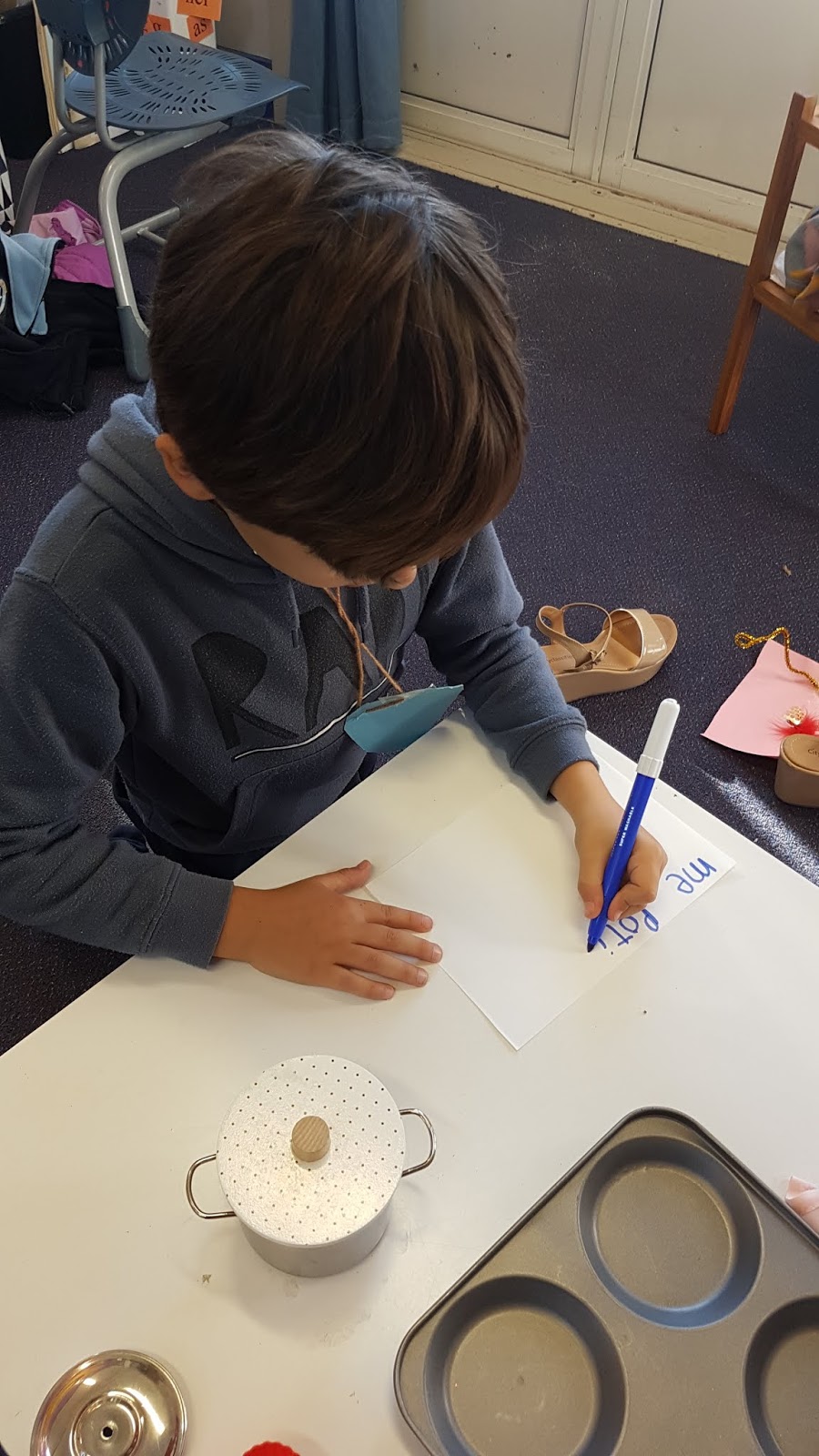
Louie, Mathew and Harry are using props/symbols in replacement of actual items for their play.  This is showing increased ability in pretend play.

Harley and Eli substituted sand with a yellow piece of fabric.
Eli has created a security camera out of substituted goods.


When working on capacity; Ozzy, Laycee, Harley, Holden, Edan and Cora-Lee all identified taller vessels as being capable of holding the most amount of water.  Therefore showing an irreversibility factor.


When sitting back and watching play, it was obvious that the children were needing coaching around different ways to solve a problem with our peers.  The children are all ego-centric and unable to see the points of view of others.  As a result, children were resulting to hitting or yelling to solve problems.  Daily modelling sessions for solving problems was introduced at brainfood time (or just before) and a variety of resources are used.  Puppets, Sesame St clips and picture books to name a few.  Role playing scenarios is highly enjoyable - making sure to always have the children be the 'good guy' as per IY guidelines.


CURRICULUM
How do I know?

Using last year's pass-on data and my Term 1 testing, I was able to set up tracking sheets for JAM and Running Record testing.


After moderating and reflecting on the student's writing, I noticed the following behaviours throughout Term 1:
  • Children will write with teacher but uninterested in writing independently.
  • Children enjoyed writing own choice stories the most.
  • Two most capable independent readers (NZ European girls) were lacking vocab in written language.
  • Not a high mileage for writing happening in Room 5 in first 6 weeks of the year.
  • My first observation of the year reflected that my team leader wanting a focus on handwriting in my daily programme to help my students write longer pieces and quicker (with more ease).
  • National Standards data and SOL (student ownership of learning) is the focused pass-on data received so unsure of wider curriculum understandings and efficacies.
PLAY
Urges

How do I know?
Observations of the children in play during the first 8 weeks of school showed that the major urges that children were exhibiting were/are:

Enclosure
Construction
Orientation
Deconstruction

STUDENT VOICE

What stuff do we do in class that is learning?

03.03.18
I asked the children this simple question and plugged the answers that the children gave me into Wordle.  The children could have as few or as many answers as they liked.  They couldn't see or hear the answers that previously children gave.  All children answered the question.